
Forward Fold · Advanced
Tortoise Pose
Kurmasana·कूर्मासन·kūrmāsana
Also called: Tortoise
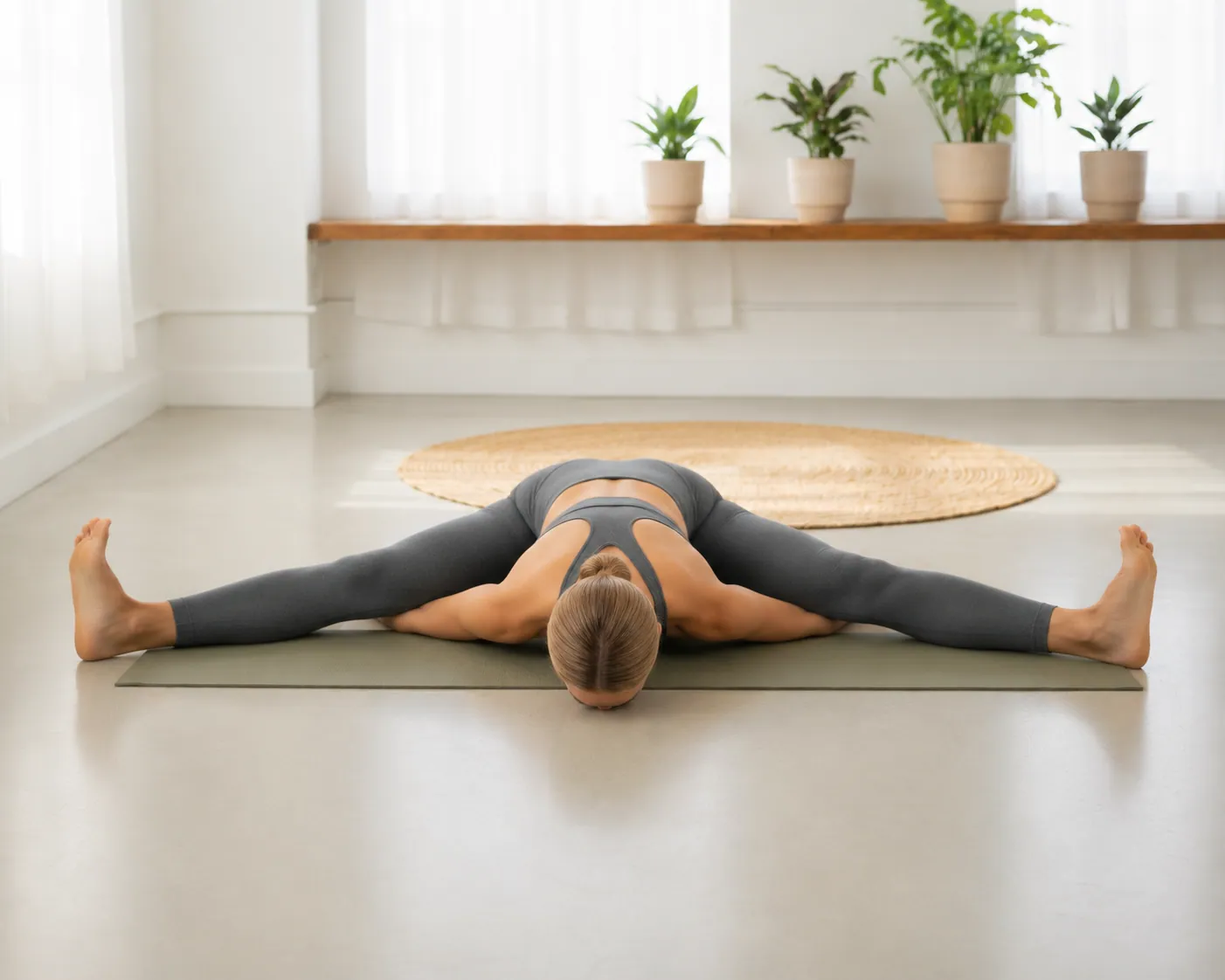
Kurmasana is one of those poses where the geometry teaches you what's possible only after years of patient hamstring work. For most users it's aspirational; for those with the mobility, it's one of the most quietly transformative shapes in the catalog — deep withdrawal as practice.
Benefits
- Deep release through the entire posterior chain (back, hamstrings, calves)
- Hip-opener through external rotation under load
- Calms the nervous system — the inward fold is contemplative
- Connects modern practitioners to one of HYP's foundational shapes
How to practise Tortoise Pose
- Sit with the legs extended in a wide V.
- Bend the knees and place the feet flat on the floor about a leg-length apart, knees pointing up.
- Lean forward and thread each arm UNDER the corresponding bent knee.
- Walk the hands out to the sides under the thighs until the shoulders sit beneath the knees.
- Slowly straighten the legs as the torso lowers toward the floor.
- Rest the forehead or chin on the floor; the chest reaches toward the floor.
- Hold for several breaths. To exit: bend the knees, walk the hands back, sit up.
Suggested hold: 60s · Breath: Paced
How Tortoise Pose affects your doshas
In Ayurveda the same pose lands differently depending on your constitution. This is the lens the app uses to sequence your practice.
| Dosha | Effect | Notes |
|---|---|---|
| Vata | Balancing | a good fit — helps settle this dosha |
| Pitta | Balancing | a good fit — helps settle this dosha |
| Kapha | Neutral | broadly neutral |
Balance it off the mat, too
Poses and food are two sides of the same balance. Calm the same dosha on your plate:
Who should avoid or modify this pose
- ADVANCED pose — work with a teacher before attempting solo
- Don't practice with herniated disc, acute lower-back injury, or severe sciatica
- Skip with knee or hip injury
- Pregnant women shouldn't practice — the compression is unsafe
- Avoid after recent abdominal surgery
If you're pregnant, injured, or managing a condition, check with a qualified teacher or clinician before practising.
Modifications
- Practice Janu Sirsasana or Paschimottanasana first to build the hamstring length needed
- Use a folded blanket under the hips and a bolster on the legs for restorative variant
- Keep the knees bent — straightening them is the advanced expression
- Build duration gradually; start with 15-second holds
Traditional source: Hatha Yoga Pradipika 1.22 — Named in HYP Ch. 1 alongside the other foundational asanas. Kurma is also the name of Vishnu's second incarnation as a tortoise — the pose evokes a contemplative withdrawal.