
Inversion · Intermediate
Plow Pose
Halasana·हलासन·halāsana
Also called: Plough Pose
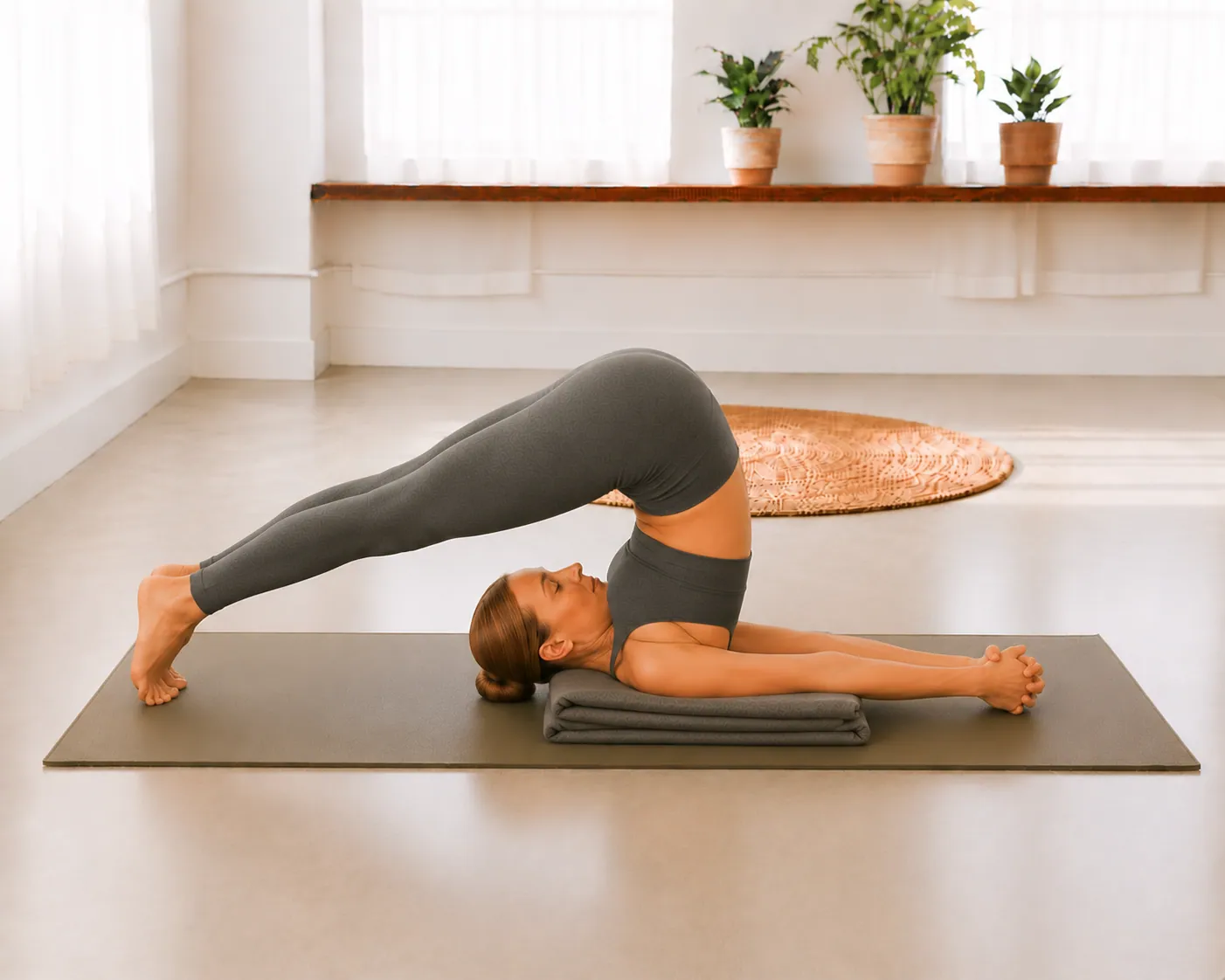
Halasana looks dramatic but is actually a quiet pose when the neck is protected with blankets and the feet are supported on a chair. For users with chronic tension between the shoulder blades from desk work, the upper-back release here is unmatched. Save the unsupported version for users who can manage Sarvangasana safely first.
Benefits
- Stretches the entire posterior chain — hamstrings, calves, lower back, upper back, neck
- Calms the nervous system through inversion + spinal flexion
- Stimulates the thyroid through the throat compression
- Traditionally taught as a sleep-inducing pose in long-hold restorative practice
How to practise Plow Pose
- Lie on your back. Bring the arms by your sides, palms down.
- Press the hands and arms into the floor as you lift the legs straight up toward the ceiling.
- Continue lifting and bring the legs over the head, lowering the toes toward the floor behind you.
- Support the lower back with the hands, fingers pointing toward the spine.
- If the toes don't reach the floor, place a chair or stack of blocks behind your head to rest the feet on.
- Keep the chin slightly tucked but DO NOT turn the head — neck stays neutral.
- To exit: support the lower back with the hands and slowly roll down vertebra by vertebra.
Suggested hold: 45s · Breath: Natural
How Plow Pose affects your doshas
In Ayurveda the same pose lands differently depending on your constitution. This is the lens the app uses to sequence your practice.
| Dosha | Effect | Notes |
|---|---|---|
| Vata | Neutral | broadly neutral |
| Pitta | Balancing | a good fit — helps settle this dosha |
| Kapha | Balancing | a good fit — helps settle this dosha |
Balance it off the mat, too
Poses and food are two sides of the same balance. Calm the same dosha on your plate:
Who should avoid or modify this pose
- Don't practice with neck injury, herniated disc, or recent neck surgery
- Pregnant women shouldn't practice — the depth of spinal flexion isn't safe
- Skip during menstruation if you find inversions uncomfortable (cultural / personal)
- Avoid with high blood pressure, glaucoma, or recent retinal detachment
- Skip with severe asthma or hiatal hernia
- Don't practice on a full stomach — wait 3-4 hours after eating
If you're pregnant, injured, or managing a condition, check with a qualified teacher or clinician before practising.
Modifications
- Place a chair behind your head and rest the feet on the chair seat — the safer default for most users
- Stack folded blankets under the shoulders so the neck doesn't bear weight (protects the cervical spine)
- Practice Legs Up the Wall instead if Halasana feels inaccessible
- Skip and substitute Setu Bandha Sarvangasana for similar nervous-system effect without the neck demand
Traditional source: Modern hatha 3.69 — Modern asana with lineage in the Hatha Yoga Pradipika 3.69 Viparita Karani mudra family. The Sanskrit 'hala' means plow — the body resembles the curve of an ox-drawn plow.