
Inversion · Intermediate
Shoulder Stand
Sarvangasana·सर्वाङ्गासन·sarvāṅgāsana
Also called: Shoulderstand, Queen of Asanas (Iyengar)
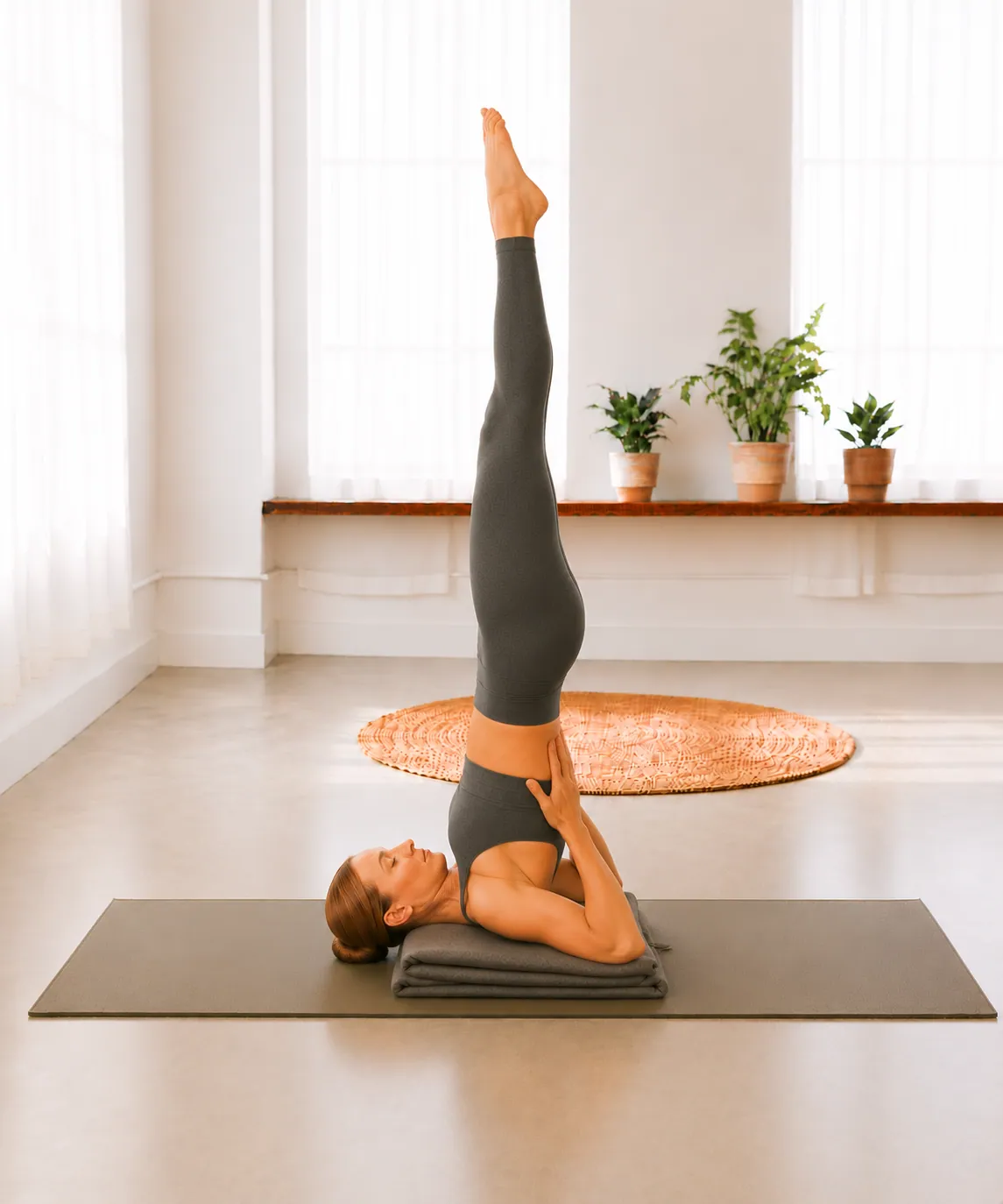
Sarvangasana is a real pose — not a beginner shape. The blanket setup is non-negotiable for protecting the cervical spine. Most users get most of the benefit from Halasana with feet on a chair, or from Legs Up the Wall — recommend those first.
Benefits
- Powerful nervous-system reset through deep inversion
- Stimulates the thyroid via throat compression
- Strengthens the shoulders, upper back, and core
- Traditionally called "the queen of asanas" in modern lineages — paired with Sirsasana, the king
How to practise Shoulder Stand
- Stack 2-3 folded blankets at the top of your mat. Lie down so your shoulders are on the blankets and your head is on the mat below them — this protects the cervical spine.
- Bring the arms by your sides, palms down.
- Press the arms into the floor and swing the legs up and over the head into Halasana.
- Bend the elbows and place the hands on the lower back, fingers pointing toward the spine.
- Slowly lift the legs up toward the ceiling, stacking the hips over the shoulders.
- The body forms one long line from shoulders to feet. Gaze at the toes.
- To exit: lower the legs back into Halasana, then support the lower back with the hands and roll down slowly.
Suggested hold: 60s · Breath: Natural
How Shoulder Stand affects your doshas
In Ayurveda the same pose lands differently depending on your constitution. This is the lens the app uses to sequence your practice.
| Dosha | Effect | Notes |
|---|---|---|
| Vata | Neutral | broadly neutral |
| Pitta | Balancing | a good fit — helps settle this dosha |
| Kapha | Balancing | a good fit — helps settle this dosha |
Balance it off the mat, too
Poses and food are two sides of the same balance. Calm the same dosha on your plate:
Who should avoid or modify this pose
- Don't practice with neck injury, herniated disc, or recent neck surgery — and never practice without the shoulder-blanket setup
- Pregnant women shouldn't practice this discrete inversion
- Skip during menstruation per personal preference
- Avoid with high blood pressure, glaucoma, or recent retinal detachment
- Skip with severe asthma, hiatal hernia, or thyroid issues
- Don't practice on a full stomach — wait 3-4 hours after eating
If you're pregnant, injured, or managing a condition, check with a qualified teacher or clinician before practising.
Modifications
- Practice Legs Up the Wall instead — same nervous-system effect, no neck demand
- Practice with a wall behind you — feet rest on the wall as a half-shoulderstand
- Build up to the full pose with Halasana first; only progress when Halasana feels stable
- Use a yoga teacher's hands-on guidance for first practice if possible
Traditional source: Modern hatha 3.78 — Modern derivation of the Hatha Yoga Pradipika 3.78 Viparita Karani mudra family. Sarvangasana as a discrete asana was codified in 20th-century lineages (Krishnamacharya, Iyengar).