
Sequence · Beginner
Sun Salutation A
Surya Namaskar A·सूर्य नमस्कार A·sūrya namaskāra
Also called: Sun Salutation, Surya Namaskara
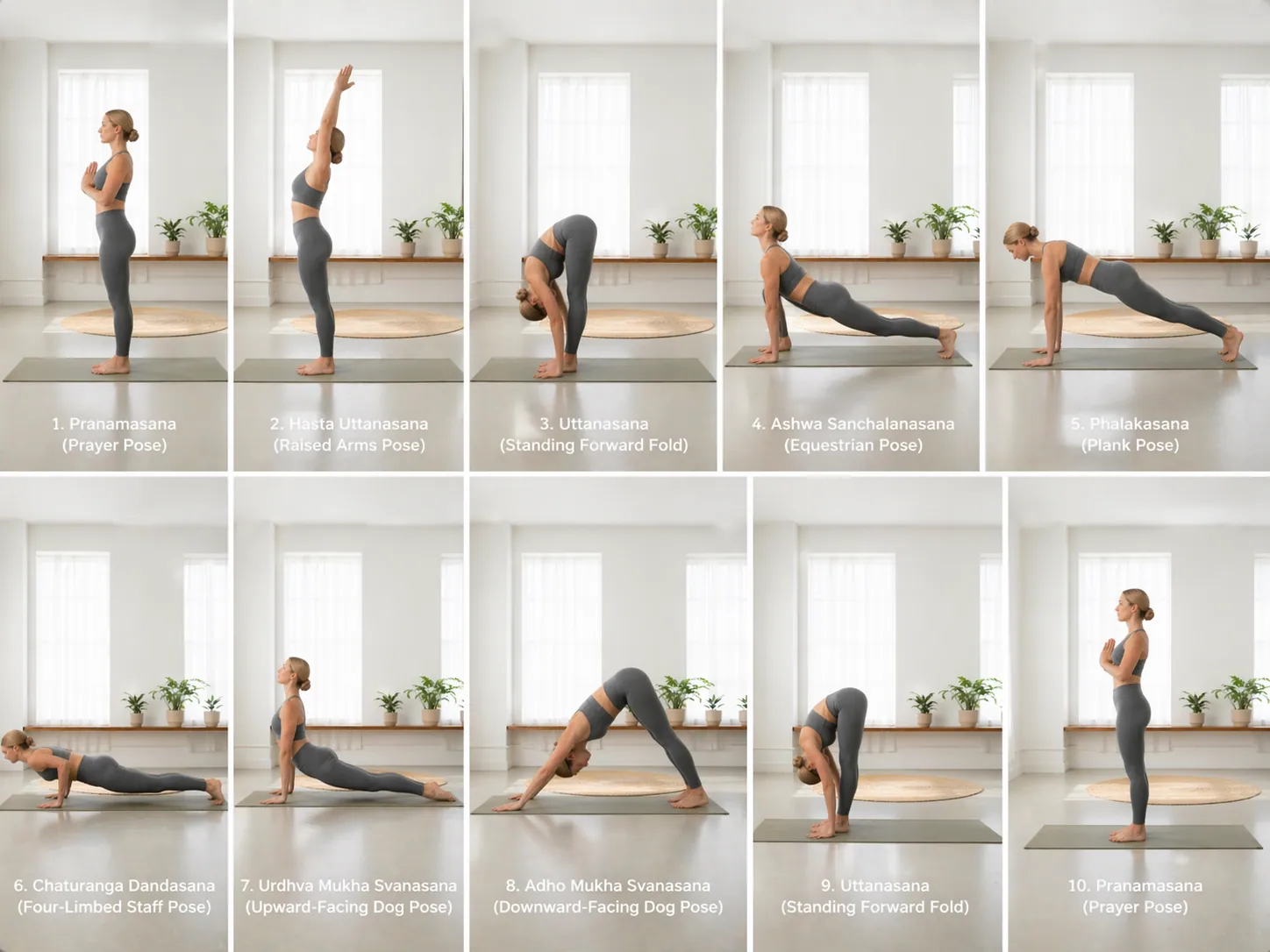
Surya Namaskar A is the canonical opening sequence of any vinyasa practice — 3-10 rounds builds heat, opens the spine, and trains the breath-led flow that everything else depends on. For users new to yoga, this single sequence is half the practice — most other asanas become accessible once the body knows this flow.
Benefits
- Most complete single sequence in modern yoga — every major muscle group, every plane of motion
- Cardiovascular and warming — builds heat for the rest of the practice
- Trains breath-movement coordination — the foundation of vinyasa
- Honors the sun's energy in the traditional context
How to practise Sun Salutation A
- Stand at the front of the mat with hands in prayer at the heart (Tadasana).
- INHALE: sweep the arms out and up overhead, slight backbend (Urdhva Hastasana).
- EXHALE: fold forward over the legs, hands to the floor (Uttanasana).
- INHALE: lift the chest halfway, fingertips on the shins, long flat back (Ardha Uttanasana).
- EXHALE: step or jump back to plank, lower halfway down with elbows close (Chaturanga).
- INHALE: roll over the toes and lift the chest into Upward Dog (or low Cobra).
- EXHALE: tuck the toes and press back into Downward Dog. Hold for 5 breaths.
- INHALE: step or jump forward, halfway lift. EXHALE: fold. INHALE: rise to standing arms overhead. EXHALE: hands to heart.
Suggested hold: 300s · Breath: Paced
How Sun Salutation A affects your doshas
In Ayurveda the same pose lands differently depending on your constitution. This is the lens the app uses to sequence your practice.
| Dosha | Effect | Notes |
|---|---|---|
| Vata | Balancing | a good fit — helps settle this dosha |
| Pitta | Neutral | broadly neutral |
| Kapha | Balancing | a good fit — helps settle this dosha |
Balance it off the mat, too
Poses and food are two sides of the same balance. Calm the same dosha on your plate:
Who should avoid or modify this pose
- Pregnant women should skip the prone phases (Chaturanga, Up Dog) — substitute Knees-Chest-Chin and Cobra
- Don't practice with severe wrist injury — modify or skip Chaturanga
- Skip with herniated disc, severe lower-back injury, or recent abdominal surgery
- Avoid with high blood pressure or recent cardiac event — too cardiovascular
- Don't practice on a full stomach — wait 2-3 hours after eating
If you're pregnant, injured, or managing a condition, check with a qualified teacher or clinician before practising.
Modifications
- Knees-Chest-Chin instead of Chaturanga for new practitioners — lower the knees, then chest, then chin to the floor
- Cobra instead of Upward Dog — keeps the hips on the floor
- Step (don't jump) back and forward
- Substitute the whole sequence with the Beginner's Sun Salutation: Tadasana → Uttanasana → Plank → Down Dog → Plank → Uttanasana → Tadasana
Traditional source: Modern hatha — Modern hatha sequence. The flowing-vinyasa form was codified by Krishnamacharya in 20th-century Mysore lineage. Devotional sun-salutation rituals predate the modern asana sequence.