
Restorative · Beginner
Crocodile Pose
Makarasana·मकरासन·makarāsana
Also called: Crocodile
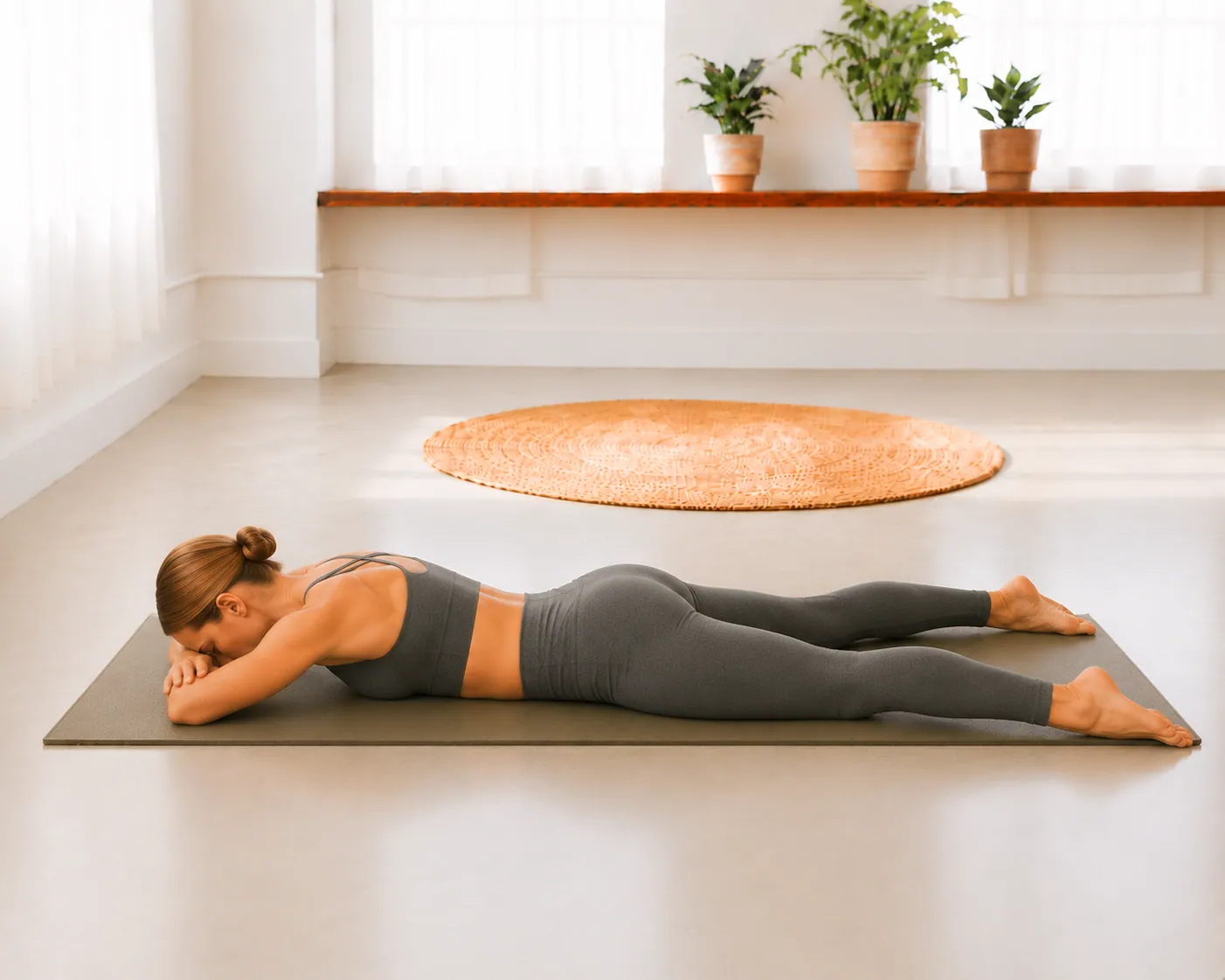
Crocodile is the recovery pose most users have never tried. The face-down geometry is unusual, but the diaphragmatic-breath training is unique — most other poses don't give the belly anything to press against. Use as a transition pose or as a 5-minute reset on a stressed day.
Benefits
- Most accessible recovery pose in the catalog — works between deeper poses or as a complete practice
- Trains diaphragmatic (belly) breathing through proprioceptive feedback from the floor
- Decompresses the lower back through gentle gravitational stretch
- Quietly therapeutic — used in some lineages for chronic lower-back rehab
How to practise Crocodile Pose
- Lie face down on a soft surface.
- Stack your forearms in front of you and rest your forehead on the forearms.
- Spread the legs slightly wider than hip-width apart, heels falling out to the sides.
- Let the body soften completely into the floor.
- Soften the jaw and the eyes.
- Breathe naturally into the belly. Each inhale presses the belly gently against the mat.
- Rest here as a recovery pose, between deeper backbends.
Suggested hold: 180s · Breath: Natural
How Crocodile Pose affects your doshas
In Ayurveda the same pose lands differently depending on your constitution. This is the lens the app uses to sequence your practice.
| Dosha | Effect | Notes |
|---|---|---|
| Vata | Balancing | a good fit — helps settle this dosha |
| Pitta | Balancing | a good fit — helps settle this dosha |
| Kapha | Neutral | broadly neutral |
Balance it off the mat, too
Poses and food are two sides of the same balance. Calm the same dosha on your plate:
Who should avoid or modify this pose
- Pregnant women in mid-to-late pregnancy shouldn't lie face down
- Skip with severe lower-back pain — try side-lying instead
- Avoid with severe heartburn or hiatal hernia
- Don't practice immediately after eating
If you're pregnant, injured, or managing a condition, check with a qualified teacher or clinician before practising.
Modifications
- Place a thin folded blanket under the belly for support if the lower back complains
- Use a bolster lengthwise under the chest for an upper-body lift variation
- Practice with the head turned to one side instead of forehead-down — switch sides periodically
- Substitute with Child's Pose if face-down isn't accessible
Traditional source: Modern hatha — Modern restorative pose. "Makara" = crocodile. Not enumerated in the Hatha Yoga Pradipika Ch. 1.